
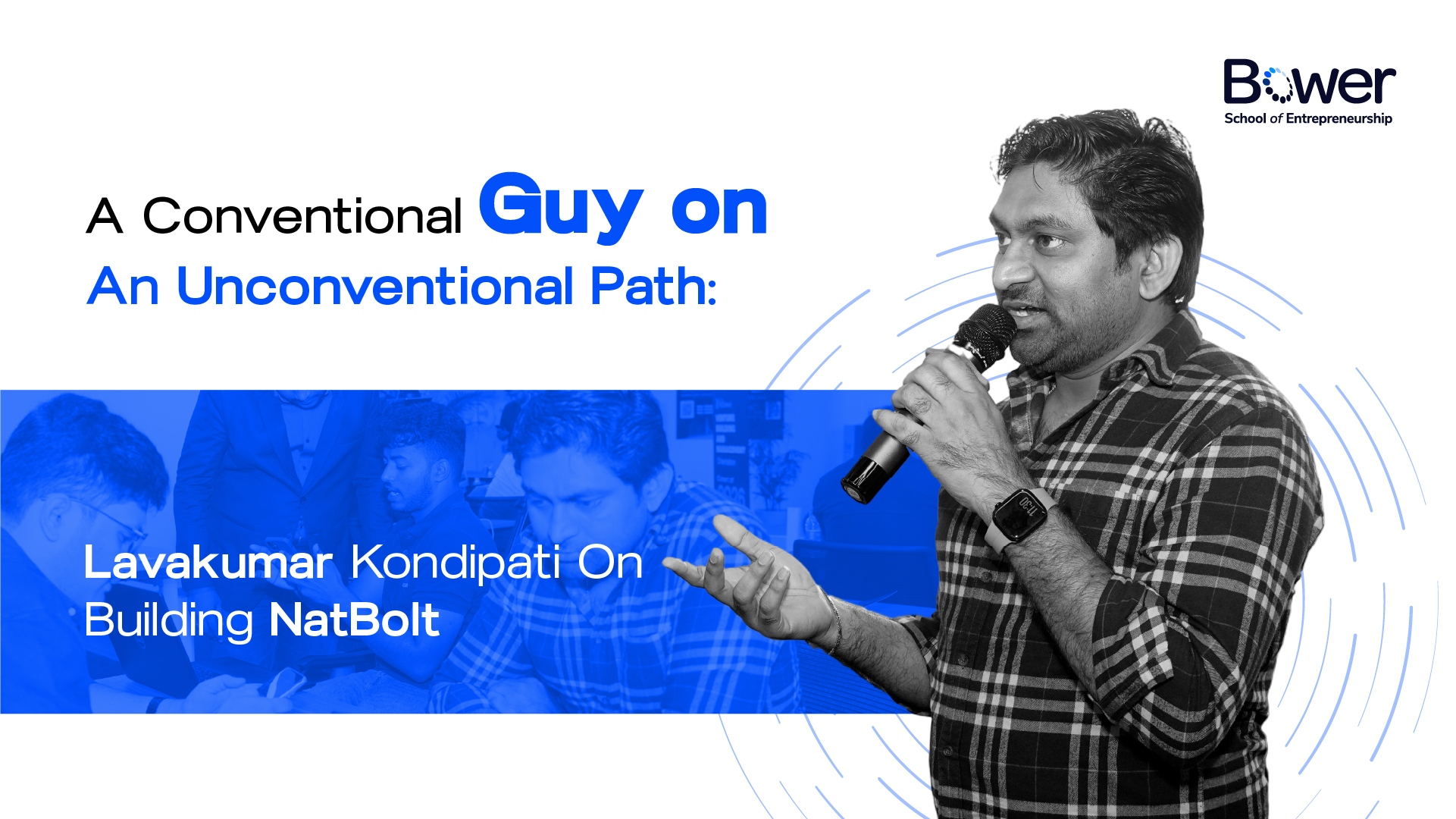
A Conventional Guy on an Unconventional Path: Lavakumar Kondipati On Building NatBolt
Entrepreneurship stories often begin with a dramatic leap: a founder quitting everything to chase a disruptive idea, armed with ambition and a pitch deck full of big promises. For Lavakumar Kondipati, the journey has looked different – more measured, more deliberate, and deeply rooted in lived experience.
When he speaks about entrepreneurship, there is little romanticism in the way he frames it. No sweeping declarations about changing the world overnight. Instead, there is patience, caution, and a quiet confidence shaped by failures, financial setbacks, and years of balancing ambition against responsibility.
"I am a conventional guy," he says matter-of-factly.
This sentence explains everything that followed in his entrepreneurial journey. Because while much of the startup ecosystem gravitates toward fast-moving trends and attention-grabbing ideas, Lavakumar has consciously moved in the opposite direction.
"I am the guy who looks at what is left behind," he says. "What nobody is touching."
That instinct has now culminated in NatBolt, a startup focused on rethinking the fragmented world of two-wheeler repair and maintenance. But the story of NatBolt is also the story of a founder who learned — sometimes painfully — that meaningful ventures are rarely built quickly. They are built deliberately.
Entrepreneurship, Before He Had a Name for It
Lavakumar did not grow up in a family of business owners. Coming from an agricultural background, entrepreneurship was neither inherited nor expected. The safer, more familiar path was education followed by employment. But even before he entered the corporate world, there were early signs of a different instinct at work.
During his engineering years in Hyderabad, he found himself drawn less to classroom routines and more to people building things in the real world — organising guest lectures, inviting professionals from DRDO and industry circles, actively seeking exposure to those who had already charted unconventional paths.
"That's where I started picking up how industry experts were talking, what they had started and where they had reached," he recalls.
Still, practical realities prevailed. After graduation, he entered the IT sector, eventually building nearly two decades of experience in technology across Hyderabad and Bengaluru. Entrepreneurship never fully left his mind, though. It sat quietly in the background, waiting.
"It was always there," he says. "I just didn't know where to go with it."
Learning Through Trial and Loss
He found his way back to his passion through a small ice-cream cart that he launched near KPHB a few years ago, experimenting with premium toppings and combinations inspired by products he had encountered outside the city. At a time when roadside food was typically positioned for affordability, he was charging between ₹50 and ₹100 per scoop — betting on product differentiation and presentation. For several months, it worked. Daily earnings came in. He gained firsthand experience in customer behaviour, sourcing, operations, and execution.
External challenges eventually forced him to shut it down, but rather than retreating, he took a larger leap: acquiring the master franchise rights for an ice cream brand across Andhra Pradesh and Telangana. At its peak, the business operated nearly five outlets in Hyderabad.
The outcome was far from what he had hoped. Operational inefficiencies, high product costs, limited marketing support, and challenges in franchise alignment gradually pushed the business into losses. Eventually, in 2018, the venture had to close — and the financial impact was significant.
"These losses were way beyond my earning capacity, so I upskilled, rose through the ranks, climbed up the corporate ladder, and spent a few years repaying the losses," he shares.
Yet even now, Lavakumar resists framing that period solely as a failure. "What I learned was not what to do," he says. "At least I learned what not to do." The lessons were concrete: how operations function at scale, why partnerships matter, how product-market fit shapes sustainability. And they formed his baseline when he stepped into the entrepreneurial world again, with a sharper focus, last year.
Looking Where Others Are Not
When Lavakumar re-entered the startup ecosystem, something about the landscape increasingly bothered him. Many founders, he felt, were moving toward the same sectors, the same narratives, the same ideas. He wanted something different that was largely overlooked.
"If everybody is going in one direction," he says, "I look at what people are leaving behind."
That search led him to an industry most people interact with regularly but rarely think deeply about: maintenance and repair. The more he explored, the clearer the opportunity became. For decades, much of the automobile repair ecosystem — especially in the two-wheeler market — had continued operating through largely traditional systems, even as technology, mobility, and customer expectations changed rapidly around it.
He initially considered four-wheelers, but quickly recognised the barriers: significant capital requirements, heavier competition, and greater operational complexity. Two-wheelers offered something more practical.
"Going on a big and landing in the smaller one is foolishness," he says. "Instead, you start with a small and go with a big."
His thinking gradually evolved into what would become NatBolt. But the idea he first imagined is not the same one he is building today. That shift came through a process of questioning, validation, and a fellowship that would reframe his entire approach.
The Bower Effect
By the time Lavakumar joined Bower's LEAD program, the foundation of NatBolt already existed. He had identified the sector, understood some of the pain points, and knew broadly where he wanted to build. What he was still searching for was a sharper direction.
Balancing a full-time corporate career alongside entrepreneurial ambitions meant time was limited. Trial and error without structure was expensive — financially and mentally. "If I'm going just like that, I can't spend all my time figuring things out," he says. "Someone has to give the right path."
Before Bower, Lavakumar's thinking around NatBolt had been centred primarily on the end customer — vehicle owners seeking better maintenance experiences. But as discussions, mentor interactions, and validation exercises progressed, the lens began to shift in ways he hadn't anticipated.
Through structured problem validation and conversations within the classroom, he found himself asking a different question: what if the real bottleneck in the ecosystem wasn't the customer experience, but the people delivering the service?
"Everybody is focused on the customer problem," he says. "But nobody was talking about the people solving the problem — the mechanics and the garages."
That insight became pivotal. Instead of building solely for customers, NatBolt started evolving into a system-first model — one that focuses on enabling garages, mechanics, and backend operations before aggressively pursuing customer acquisition. It was a fundamental reorientation, and it emerged directly from the fellowship's structured process of stress-testing assumptions.
Lavakumar is specific about what Bower gave him: not an idea, but the rigour to refine one. Mentorship around validation — including insights from faculty and mentors — helped him think more systematically about execution and narrow his focus with greater conviction. "It gave me a butterfly effect," he says. "I evolved a lot from before Bower and after Bower."
For a founder balancing professional obligations with a startup, the structure mattered as much as the network. He describes his pace as moving in "turtle mode."
"But with a clear focus," he adds.
Building Slowly, Testing Constantly
Today, NatBolt is already in motion. Drawing from his software engineering background, Lavakumar has built an operational software system for local garage owners — designed specifically to be simple, functional, and easy to use, helping garages manage customer records, track parts, and improve day-to-day workflows.
Rather than assuming what users might want, he placed the product directly into local garages and began collecting feedback from real operators. "Instead of me testing and assuming things," he says, "I directly gave it to the garage owners." The feedback loop has become central to NatBolt's evolution: more garages mean more insights, more behavioural understanding, greater operational clarity.
He is also deliberately cautious about projections untethered from evidence, a disposition shaped as much by past losses as by principle. "I wanted to show some numbers," he says. "I don't want to say this market is huge, and if we get one percent, we'll become this. No. We have traction, we have numbers, only then we can talk."
For Lavakumar, scale is not the first objective. Understanding is.
Staying Grounded While Thinking Long-Term
Ask him where he sees NatBolt in the future, and the answer is ambitious but characteristically grounded. His long-term vision is to build a maintenance and repair network that supports mobility businesses at scale — a trusted backend ecosystem for brands entering the automotive space. Yet even as he speaks about growth, there are no grand promises, no urgency to chase appearances.
His advice to aspiring founders reflects much of what his own journey has taught him. "Don't quit on the first day itself," he says. "Do baby steps first." For him, entrepreneurship is not about certainty from the beginning. It is about learning through repeated validation, testing assumptions against reality, and building confidence through evidence rather than instinct alone.
"The vision you wanted to look at — nobody else can see it," he says. "Only you can look at it. But don't assume things. Go to market first."
It is advice shaped not by theory, but by experience — by ice cream businesses and franchise losses, by years of professional rebuilding, by a fellowship that sharpened a rough idea into a real one. The conventional guy, it turned out, was also a patient one.
In a landscape driven by speed, he has chosen patience. In an ecosystem chasing visibility, he has chosen conviction. A conventional man, perhaps.
On an unconventional path.
.jpeg)