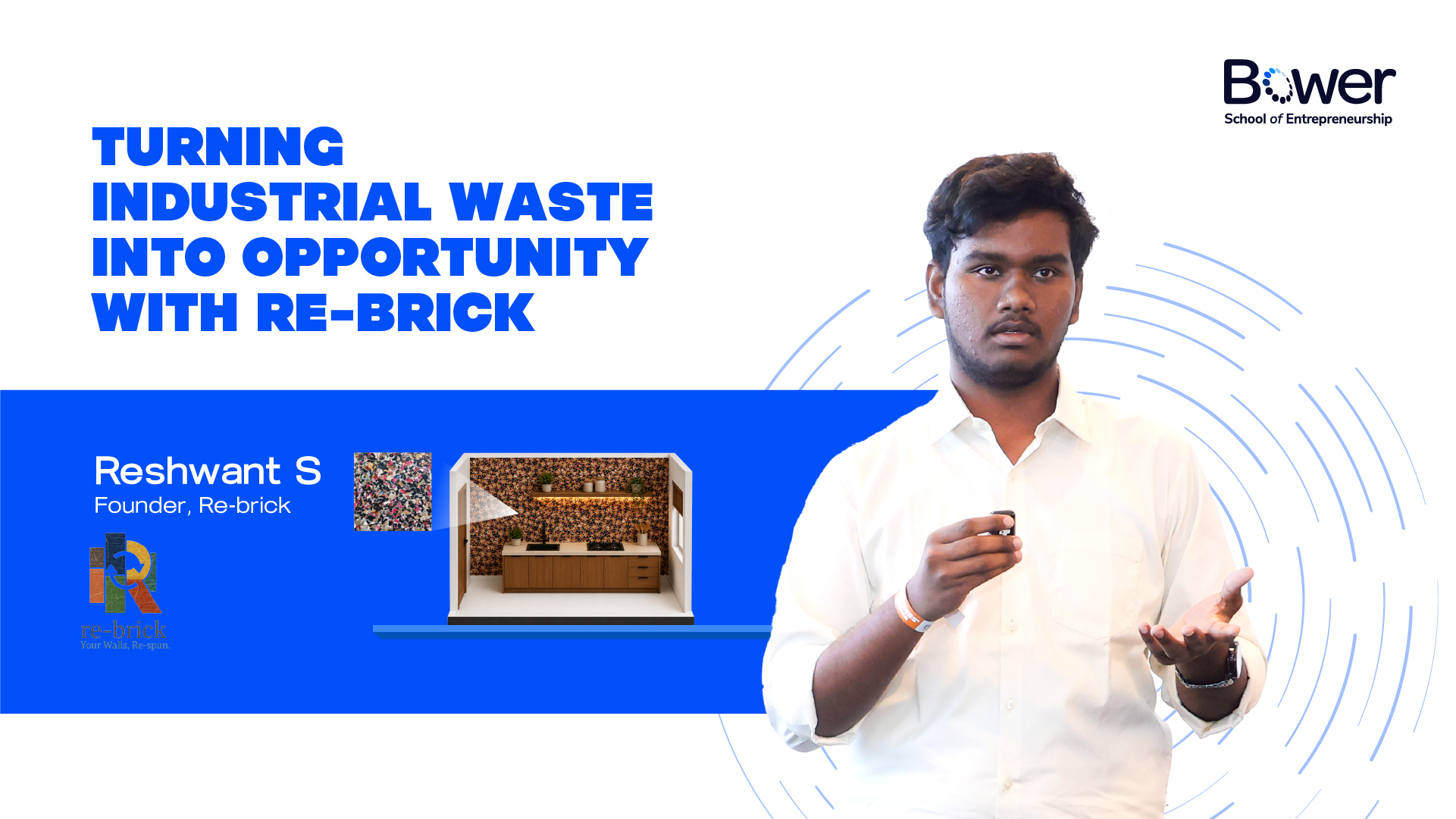
Reshwant S: Turning Industrial Waste into Opportunity with Re-brick
The granite and marble industry had shaped Reshwant S's life long before he thought about starting a company of his own. It was the family business, founded by his grandfather in the 1990s and later expanded by his mother into an export enterprise that earned India's Best Exporter Award in 2017. Continuing that legacy seemed like the obvious path.
But while preparing to do exactly that, Reshwant found himself questioning one aspect of the business: the amount of waste it generated. While still in Class 12, he began researching ways to reduce the industry's environmental footprint and explore whether some of that waste could be repurposed.
That search eventually led him to Re-brick, a venture developing furniture, wall cladding and other products using recycled textiles and sustainable materials.
Looking at a Family Business Differently
The idea behind Re-brick took shape through conversations at home.
While discussing environmental pollution with his mother, Reshwant learnt more about the textile waste and water used during marble and granite manufacturing. Curious to see whether there was a more sustainable alternative, he began researching materials and production processes that could reduce the industry's carbon footprint.
He shares, "I was researching how to reduce the waste and decrease the carbon footprint of the industry. That's when I found that recycled textiles could be used to create furniture like coffee tables, decorative pieces, and wall cladding."
Research soon turned into experimentation. But before there was a prototype, there was guidance.
His mother, who had spent years growing the family business, helped him identify suppliers, understand manufacturing, estimate production costs, and navigate the practical realities of product development.
"My mother helped me search for suppliers and understand how to manufacture the product. She helped me build the prototype, understand the costs, and figure out how to reduce them. She has been an essential part of my journey," he very proudly highlights.
That early support allowed him to move beyond the idea stage and begin building prototypes using resources already available at the family's factory.
Finding the Right Idea
However, Re-brick wasn't the first idea Reshwant explored.
Before arriving at sustainability, he spent time thinking about products for the defence sector, including bulletproof vests and tracking technologies for soldiers. Conversations with founders already working in the space, however, made him realise how difficult it would be to enter such a specialised industry without an engineering background.
By the time he joined Bower BUILD, he was still trying to decide which direction to pursue.
The clarity came during one of his early classes: "One of my teachers told me, 'You don't need to focus on two or three ideas. You need to focus on one idea and make it work.' Since then, Re-brick became my main idea," he quips.
The advice helped him narrow his focus. Rather than dividing his time across multiple ideas, he committed himself to Re-brick and built his first working prototype.
His first year at Bower also exposed him to a side of entrepreneurship that extended beyond product development. Through interactions with founders, mentors and investors, he learnt how businesses are positioned, pitched and refined.
"I got to know how the real world works. I learnt how to pitch my product and create presentations that capture investors' attention. In a way, it made me the man I am today,” he shares.
He also credits Bower's mentorship ecosystem for helping him think beyond his initial target audience. Conversations with industry experts encouraged him to explore new materials, refine his product, and identify wider market opportunities.
Reflecting on his experience, Reshwant believes entrepreneurship can be pursued from any educational background, but programmes dedicated to building founders offer a distinct advantage.
"It is not a necessity," he says, referring to entrepreneurship-focused education, "but it is definitely an advantage because you get access to a wide variety of mentors."
One Prototype, Many Possibilities
Re-brick is still in the prototyping stage, with Reshwant continuing to experiment with formulations and product applications.
The startup's prototype focuses on furniture and wall cladding, including coffee tables, dining tables and decorative applications. Alongside this, he is also exploring two additional concepts—a construction brick and an interchangeable brick system. The products are being developed using recycled textiles, biodegradable resin, natural hardeners and rice husk ash, with raw materials currently sourced from the family's factory.
Even as the product evolves, one constant has remained: his family's support.
"My mother and grandfather took risks that even today I would be afraid to take. They still help me whenever I need guidance, suppliers, or introductions," Reshwanth points out.
He expects to begin production in the coming months. By the end of 2026, he hopes Re-brick will have 50 to 60 revenue-generating customers. Looking further ahead, his plans include setting up a manufacturing unit, expanding into international markets and securing patents and trademarks for the technologies he is developing.
Re-brick is still evolving, but its purpose has remained unchanged since the day its founder began asking how industrial waste could become something more valuable.