
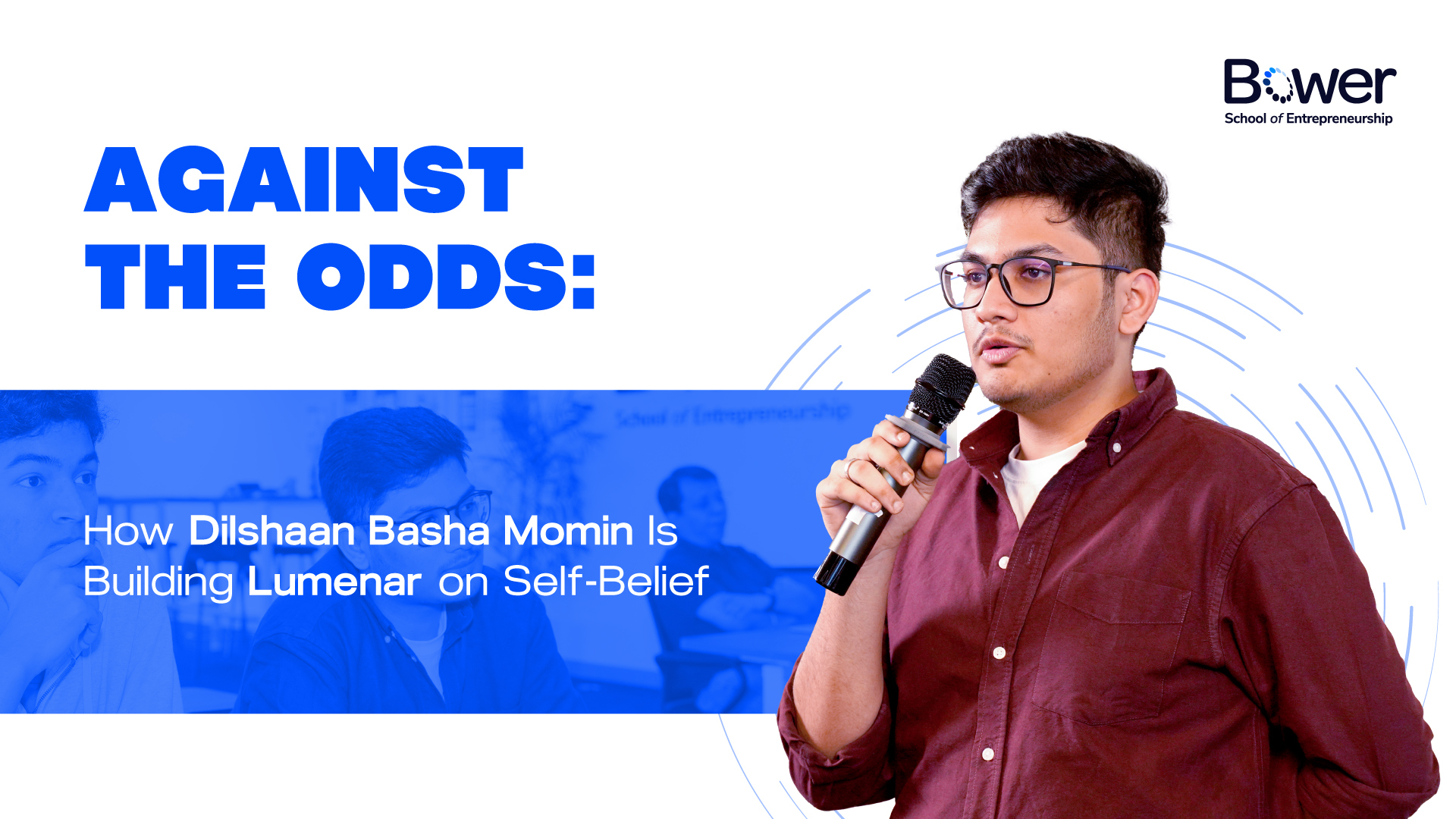
Against the Odds: How Dilshaan Basha Momin Is Building Lumenar on Self-Belief
In October 2025, Dilshaan Basha Momin did something that made almost no sense on paper. Midway through his international master's programme in Sweden — with his academics on track and career doors beginning to open — he flew back to India. Not for a holiday. Not for a family emergency. To save a startup that was already fracturing.
A co-founder's split had stalled months of work. The idea he had been building was losing its footing. His parents, who had watched business ventures collapse before, were worried. And Dilshaan, by his own admission, was stepping into the deepest uncertainty of his life so far.
“At that time, I didn’t know what to do. I was very, very unclear. I had put everything at risk: my master’s, my career path, everything. I was very unclear. Had to face these questions for the first time,” he notes.
For most people, that would have been the moment to cut losses, finish the degree, and take one of the well-paying jobs already on offer. For Dilshaan, it was the moment he decided to stay in the game and figure out what game he actually wanted to play.
Learning From Grandfather's Smile
Dilshaan grew up in Kurnool, Andhra Pradesh, before moving to Hyderabad, the city that would shape most of his formative years. He describes himself as a "tech geek" from early childhood, partly because his uncles kept him supplied with gadgets and an appetite for how things work.
He smiles as he reminisces, “I used to question everything. I remember asking my dad in first or second standard what the difference between miles and kilometres was. I couldn’t understand why people measured things differently.”
But technology alone didn't seed the entrepreneurial instinct. That came from watching his grandfather: a man who started by pulling a cart of soda bottles on the road and built his way up to running a theatre and more. It wasn't the success that stayed with Dilshaan. It was something harder to name.
“Looking at him going through failures and still sitting with a smile that shaped me,” he highlights, “I realised business is all about that.”
But before starting his entrepreneurial journey, he wanted to take the conventional path to hone his technical skills further. He toiled hard to get admission in one of the IITs but could not get through in his first two attempts.
He ended up at Jawaharlal Nehru Technological University Hyderabad (JNTUH), in a distinctive five-year Computer Science programme with the final stretch in Sweden. Though he cleared his JEE test after that, something inside him prompted him to stay where he was. At the time, it felt like a consolation. Looking back, it was the right door.
Building Before Building a Company
At JNTUH, Dilshaan didn't just study; he led two of the most active technical clubs on campus: the Google Developers Club and the Algorand Blockchain Club, collectively building communities of over 1,500 students.
What he found there wasn't just technical depth. He found evidence of his own capacity to aim higher than the room expected. During one cohort initiative, when the team set a target of 80 registrations, he pushed for 120, a number most considered impossible. They hit it.
"Why not?" became a recurring instinct. Not recklessness but a deliberate refusal to let the group's comfort zone set the ceiling. These early wins weren't just achievements. They were proof-of-concept for a mindset he would need badly in the years ahead.
The Fallout and the Hard Truths
By the time ge graduated from JNTUH and packed his bags for Sweden, he had already co-founded a supply chain company with his friends from the university. The promising startup had gained real traction: incubation at T-Hub in Hyderabad, hackathon wins, and early validation.
But with Dilshaan moving to Sweden and his co-founders on the ground in India, cracks started forming. It was then that he took a break from his master’s and flew back to India for a short stay, in the hope of sorting things out with his partners. Albeit, he eventually decided to step away from the project and ventured out on his own, back to the drawing board.
He walked into roughly 50–60 kirana stores. He cold-called around 100 distributors. He eventually got through to a Hindustan Unilever distributor who managed 1,500 stores and was clocking multi-crore monthly revenues. By any measure, that was traction.
But the more time he spent in the supply chain trenches, the clearer and harder truth became: he didn't have founder-market fit. Building meaningfully in that space would take five to ten years of immersive operational experience he hadn't yet accumulated. Another pivot, another reset.
"I fell back to zero. It was exhausting,” he shares,“But I feel like I had to go through that because it made me prepared — I shouldn't be in that place again. Risk is something I don't want to take blindly. I have to be well-planned."
The Strategic Pivot
By early 2026, Dilshaan found himself utterly confused and with a deep sense of responsibility to make things work. His family had seen failed businesses and were already skeptical of his choice to start one of his own. And at that moment it almost felt like they were right. But he did not give up.
The initial pump came from Bower LEAD’s founder, Pavan Allena, who told him that the earlier fallout could be a blessing in disguise.
Dilshaan, thus, pivoted and zeroed in on a problem that matched his actual strengths: the gap between enterprises that want to adopt AI and the reality of integrating it into systems they already run.
The company he founded, Lumenar Global Pvt Ltd, helps enterprises and SMEs become AI-native; not by replacing their existing infrastructure, but by working within it. As large organisations across industries accelerate automation and reduce headcount in favour of AI-driven workflows, the bottleneck isn't the AI. It's the integration.
“The main concern that people are seeing is integration of AI into the systems they already have. That’s where we come in. We are the enterprise AI architect for them. We go ahead and properly plan how your enterprise can leverage AI in the right way and boost productivity,” he highlights.
Lumenar is early-stage and intentionally lean: a team of four, with a fifth joining soon. Dilshaan is clear-eyed about not wanting to scale headcount for its own sake: with AI-augmented workflows, a small team can execute at a level that would have required three times the people just a few years ago. The company is currently generating monthly revenue from its first client, with Dilshaan now using his time in Sweden to explore the European market before his visa window closes.
He turned down a LinkedIn-sourced job offer of $90,000–$150,000 to stay on this path. But at the same time has a clear realisation that if the business doesn’t work, he could get a good-paying job in one of the European cities, a continent that he has fallen in love with.
The Bower LEAD Effect
While Dilshaan was always keen on exploring entrepreneurship as a career path and had walked in the Bower campus with an idea already in motion, what LEAD gave him was confidence and clarity. He explains, ““In Bower, the entire perspective I had on entrepreneurship was proven true. What I believed but had no proof for — Bower showed me: yes, what you believe is true. Now you can draft yourself to be the person you want to be.”
His biggest role model became Pavan Allena. Hearing how he had started Metamorphosis with practically nothing and watching that story map so precisely onto his own non-linear path —gave Dilshaan a different relationship with difficulty. Setbacks stopped feeling like signals to stop and started feeling like standard issue. He didn’t need to be told to keep going. He needed to see that others had.
Beyond mentorship, Bower became a place where the messy, non-linear path he was on was treated not as a problem but as a pattern. The community normalised difficulty.
He also contributed back: training students at a Bower summer camp, watching them pick up programming at speeds that would make senior CS undergrads nervous. That experience sharpened his thinking on adaptability. If he wanted Lumenar to stay relevant, he'd need to keep learning at the same pace he was asking of others.
One Life. Keep Moving.
Ask Dilshaan where he sees himself in a decade, and the answer isn't a city, a valuation, or a job title. It's a way of being.
He fell in love with Stockholm. He's intrigued by how European enterprise tech is structured. But permanence, anywhere, doesn't appeal to him. He wants to build globally, explore continuously, and stay close to wherever technology is evolving fastest.
"I just want to see myself not sitting constantly in one place. I want to explore the world. I want to understand how things are evolving. I just got one life."
That’s one of the reasons that he named his venture Lumenar Global, to expand beyond geographical boundaries and utilise his skills to the fullest. He is driven by this instinct to keep flowing; it is the same instinct that sent him back to India mid-masters, that kept him walking into kirana stores after a co-founder split, that made him pivot when it seemed like the end.
His biggest learning in this journey has been how to “risk manage”, not just his enterprise but himself as well. He is carefully curating his future and is quite open-minded about the possibilities that lay ahead – be it related to scaling the business or being job ready in today’s market.
But one thing is for sure, Dilshaan’s belief in self and his conviction in his own skills is going to be factor that shapes his path ahead.
.jpeg)